dataset
|
example
|
python tools/download-dataset.py facades
400 images from CMP Facades dataset. (31MB)
Pre-trained: BtoA
|  |
python tools/download-dataset.py cityscapes
2975 images from the Cityscapes training set. (113M)
|  |
python tools/download-dataset.py maps
1096 training images scraped from Google Maps (246M)
|  |
python tools/download-dataset.py edges2shoes
50k training images from UT Zappos50K dataset. Edges are computed by HED edge detector + post-processing. (2.2GB)
Pre-trained: AtoB
|  |
python tools/download-dataset.py edges2handbags
137K Amazon Handbag images from iGAN project. Edges are computed by HED edge detector + post-processing. (8.6GB)
Pre-trained: AtoB
|  |
Showing posts with label image. Show all posts
Showing posts with label image. Show all posts
Monday, 20 April 2020
GAN, image segmentation dataset

image segmentation dataset list
- Stanford Background Dataset
- Sift Flow Dataset
- Barcelona Dataset
- Microsoft COCO dataset
- MSRC Dataset
- LITS Liver Tumor Segmentation Dataset
- KITTI
- Pascal Context
- Data from Games dataset
- Human parsing dataset
- Mapillary Vistas Dataset
- Microsoft AirSim
- MIT Scene Parsing Benchmark
- COCO 2017 Stuff Segmentation Challenge
- ADE20K Dataset
- INRIA Annotations for Graz-02
- Daimler dataset
- ISBI Challenge: Segmentation of neuronal structures in EM stacks
- INRIA Annotations for Graz-02 (IG02)
- Pratheepan Dataset
- Clothing Co-Parsing (CCP) Dataset
- Inria Aerial Image
- ApolloScape
- UrbanMapper3D
- RoadDetector
- Cityscapes
- CamVid
- Inria Aerial Image Labeling

Sunday, 19 April 2020
COVID-CT
CT images with clinical findings of COVID-19
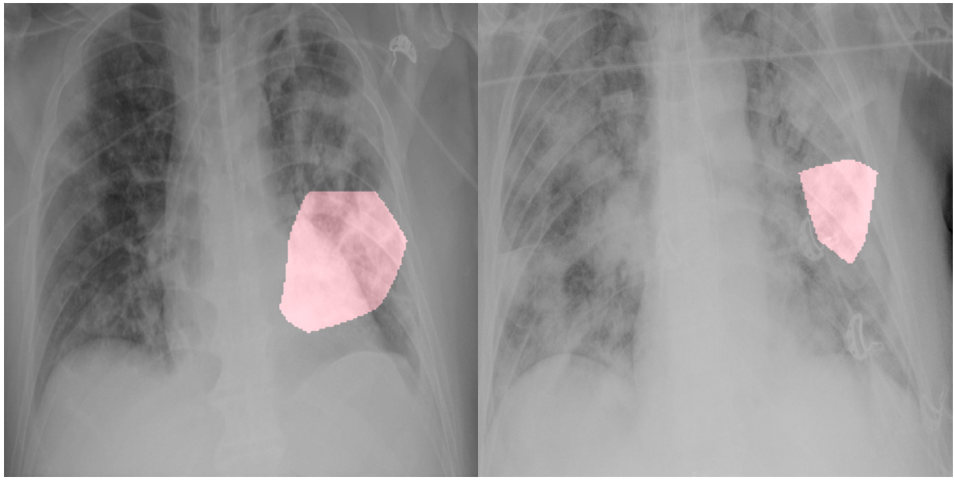
The COVID-CT-Dataset has 275 CT images containing clinical findings of COVID-19. The images are collected from medRxiv and bioRxiv papers about COVID-19. CTs containing COVID-19 abnormalities are selected by reading the figure captions in the papers. All copyrights of the data belong to medRxiv and bioRxiv.

🏡 GitHub : https://www.visualdata.io/?fbclid=IwAR2fwIhpd27Fvk7uVQ4FVroV52Fmy7u2m-7hcAT1-7TdWa1-6PmWe-NIXaM
Saturday, 18 April 2020
An Open Pan-Cancer Histology Dataset for Nuclei Instance Segmentation and Classification
Semi automatically generated nuclei instance segmentation and classification dataset with exhaustive nuclei labels across 19 different tissue types. The dataset consists of 481 visual fields, of which 312 are randomly sampled from more than 20K whole slide images at different magnifications, from multiple data sources. In total the dataset contains 205,343 labeled nuclei, each with an instance segmentation mask. Models trained on pannuke can aid in whole slide image tissue type segmentation, and generalise to new tissues. PanNuke demonstrates one of the first succesfully semi-automatically generated datasets.

The ORNL Overhead Vehicle Dataset (OOVD)
This data set was created to understand the potential for machine learning, computer vision, and HPC to improve the energy efficiency aspects of traffic control by leveraging GRIDSMART traffic cameras as sensors for adaptive traffic control, with a sensitivity to the fuel consumption characteristics of the traffic in the camera’s visual field. GRIDSMART cameras—an existing, fielded commercial product—sense the presence of vehicles at intersections and replace more conventional sensors (such as inductive loops) to issue calls to traffic control. These cameras, which have horizon-to-horizon view, offer the potential for an improved view of the traffic environment which can be used to generate better control algorithms.

3d fashion dataset
Deep Fashion3D: A Dataset and Benchmark for 3D Garment Reconstruction from Single Images

We present Deep Fashion3D, a large-scale repository of 3D clothing models reconstructed from real garments. It contains over 2000 3D garment models, spanning 10 different cloth categories. Each model is richly labeld with groundtruth point cloud, multi-view real images, 3D body pose and a novel annotation named feature lines. With Deep Fashion3D, inferring the garment geometry from a single image becomes possible.
official :


Friday, 17 April 2020
Facial Datasets
Facial Datasets
- Labelled Faces in the Wild: 13,000 cropped facial regions (using; Viola-Jones that have been labeled with a name identifier. A subset of the people present have two images in the dataset — it’s quite common for people to train facial matching systems here.
- UMD Faces Annotated dataset of 367,920 faces of 8,501 subjects.
- CASIA WebFace Facial dataset of 453,453 images over 10,575 identities after face detection. Requires some filtering for quality.
- MS-Celeb-1M 1 million images of celebrities from around the world. Requires some filtering for best results on deep networks.
- Olivetti: A few images of several different people.
- Multi-Pie: The CMU Multi-PIE Face Database
- Face-in-Action
- JACFEE: Japanese and Caucasian Facial Expressions of Emotion
- FERET: The Facial Recognition Technology Database
- mmifacedb: MMI Facial Expression Database
- IndianFaceDatabase
- The Yale Face Database and The Yale Face Database B).
- [Mut1ny Face/Head segmentation dataset] (http://www.mut1ny.com/face-headsegmentation-dataset) Over 16k pixel-level segmented images of faces/head images
Natural-Image Datasets
Natural-Image Datasets
- MNIST: handwritten digits: The most commonly used sanity check. Dataset of 25x25, centered, B&W handwritten digits. It is an easy task — just because something works on MNIST, doesn’t mean it works.
- CIFAR10 / CIFAR100: 32x32 color images with 10 / 100 categories. Not commonly used anymore, though once again, can be an interesting sanity check.
- Caltech 101: Pictures of objects belonging to 101 categories.
- Caltech 256: Pictures of objects belonging to 256 categories.
- STL-10 dataset: is an image recognition dataset for developing unsupervised feature learning, deep learning, self-taught learning algorithms. Like CIFAR-10 with some modifications.
- The Street View House Numbers (SVHN): House numbers from Google Street View. Think of this as recurrent MNIST in the wild.
- NORB: Binocular images of toy figurines under various illumination and pose.
- Pascal VOC: Generic image Segmentation / classification — not terribly useful for building real-world image annotation, but great for baselines
- Labelme: A large dataset of annotated images.
- ImageNet: The de-facto image dataset for new algorithms. Many image API companies have labels from their REST interfaces that are suspiciously close to the 1000 category; WordNet; hierarchy from ImageNet.
- LSUN: Scene understanding with many ancillary tasks (room layout estimation, saliency prediction, etc.) and an associated competition.
- MS COCO: Generic image understanding / captioning, with an associated competition.
- COIL 20: Different objects imaged at every angle in a 360 rotation.
- COIL100 : Different objects imaged at every angle in a 360 rotation.
- Google’s Open Images: A collection of 9 million URLs to images “that have been annotated with labels spanning over 6,000 categories” under Creative Commons.
Thursday, 16 April 2020
A large-scale unconstrained crowd counting dataset

👉🏻 http://www.crowd-counting.com/#download
A comprehensive dataset with 4,372 images and 1.51 million annotations. In comparison to existing datasets, the proposed dataset is collected under a variety of diverse scenarios and environmental conditions. In addition, the dataset provides comparatively richer set of annotations like dots, approximate bounding boxes, blur levels, etc.
Subscribe to:
Posts (Atom)